
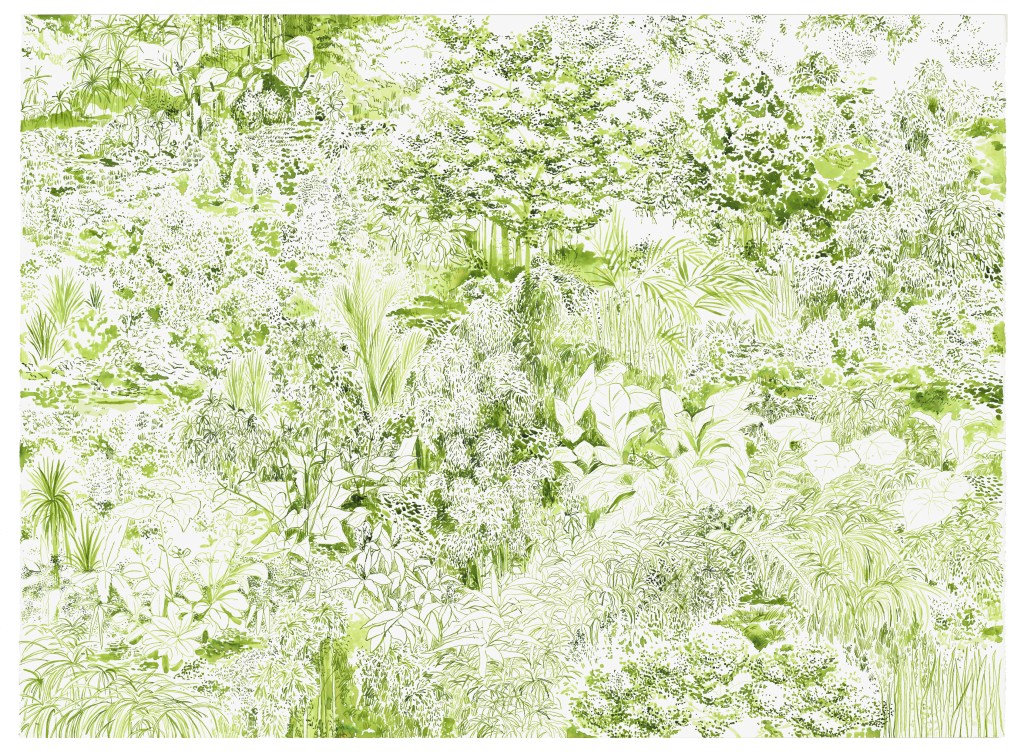
Impossible Vista
Ink on Paper, 760 x 560 mm
The suburban development of the land that surrounds my home is the key concept that underpins my practice. I am interested in nature’s various forms; gardens, green spaces, scenic reserves, and how these colliding spaces make up the backdrop of my daily life.
Impossible Vista explores the concept of an ‘impossible bouquet,’ planted into the New Zealand Landscape. This re-constructed vista, in which my plants have taken root, is an artificial representation of the natural backdrop of our everyday lives. Specimens are reduced to line and mark, allowing particular species to be camouflaged into New Zealand’s botanical potential.
This work was selected and exhibited as a Finalist in the Parkin Drawing Prize, 2021.

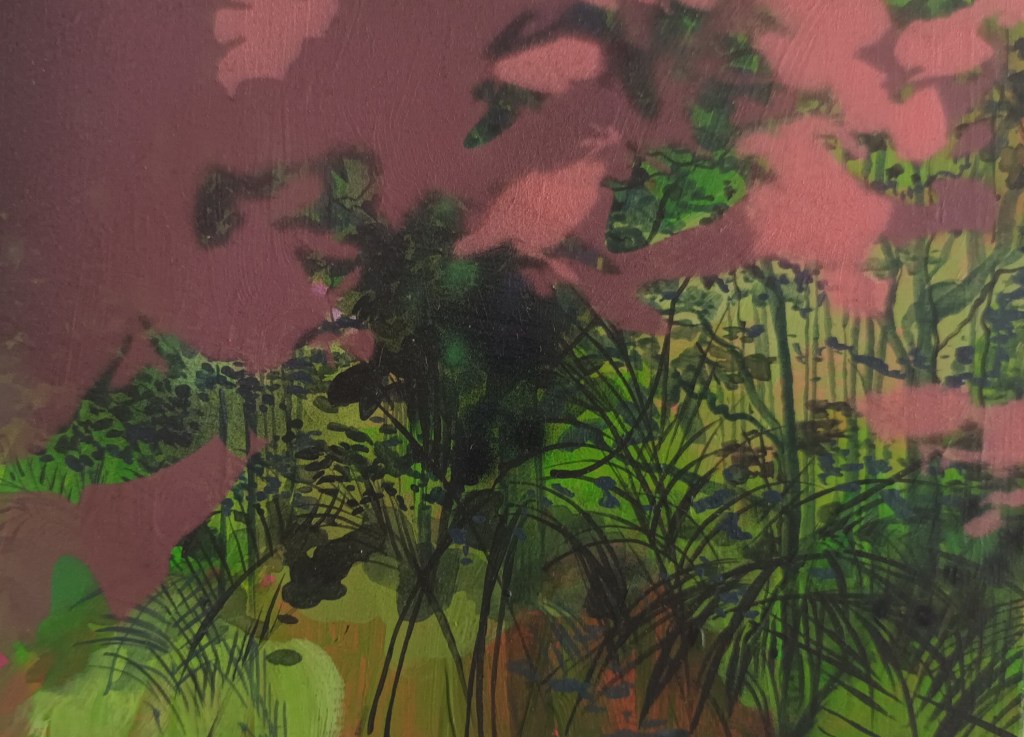
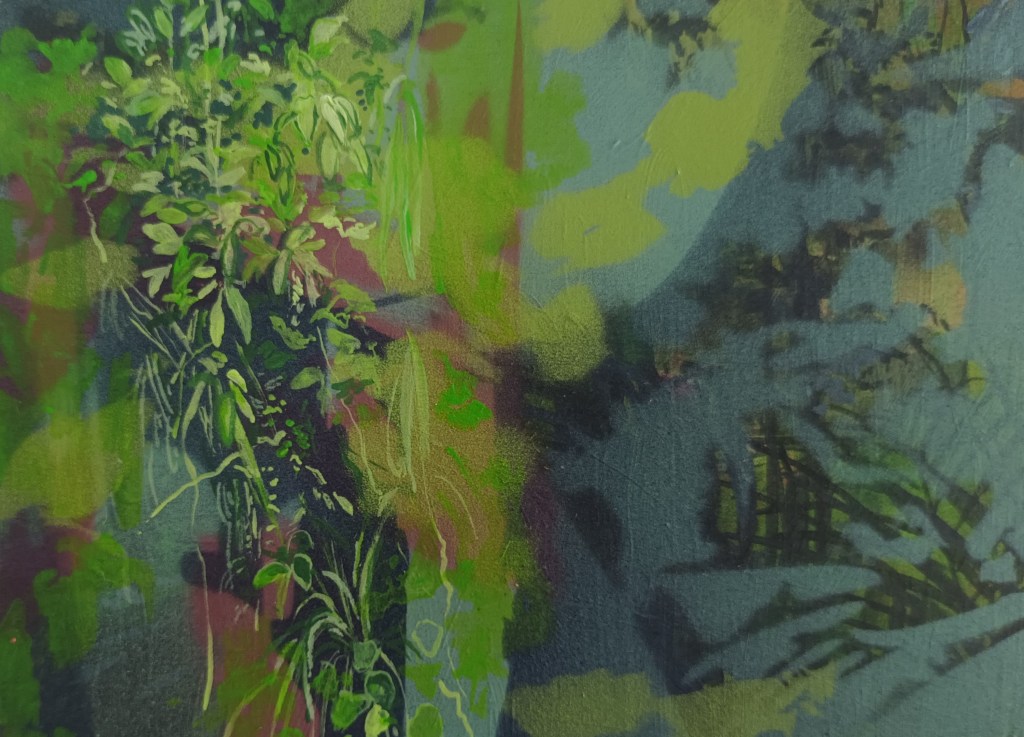
Impossible Postcards
Acrylic paint and spray paint on board, 150 x 110 mm.
My postcards are representative of a living botanical entity, one which has evolved and is evolving over time. In a Landscape Architecture discussion paper written by Kees Lokman and Susan Herrington, Gardens as Migratory Devices, the relationship of natural botanical migration and human control is explored, in the sense of garden design. “ […] the acknowledgement that plants travel and invite travel, whether on their own accord or with human agency, challenge previous conceptions of gardens as bounded spaces.” [1] My collection of Impossible Postcards responds to the locality of the Pukenui Forest Scenic Reserve and its suburban surroundings.
1. Kees Lokman & Susan Herrington, Gardens as Migratory Devices. Sourced from https://www.academia.edu/32222724/Gardens_as_Migratory_Devices, April 1st 2023.


Impossible Postcards; Interation II
Ink on Paper, 210 x 2000 mm
This body of work explores my interest in the implied reading of a postcard, in particular, the way in which the recipient is drawn into its’ ‘suggested’ reality by its frame, deliberately cropped to select the most pristine slice of each view. The collection aims to question each scene’s integrity. My Impossible Postcards; Interation II are a collection of framed viewpoints that explore the conflicting relationship between what we see and what we choose to ignore; the forests canopy vista that hides what lies beneath its green screen in contrast to sites on its periphery that employ layers of cloyed colour, simplified foliage patterns of exotic flora and introduced specimens that can make a lasting impact on the pristine forest scenes.


 Meg White Art + Design